
Well Pumps Categories

Trusted Brands We Offer

About Well Pumps

Buy Top Rated & Best Selling Well Pumps @ PumpProducts.com
"PumpProducts.com Offers Same Day Shipping On All Hot Water Well Pumps, Parts, Motors & Controls In Stock !
"Call Our Sales Counter For Assistance, Price Quotes & To Place Your Order" - 800-429-0800
PumpProducts.com is a Stocking Well Pump Distributor and we offer Well Pumps at The Guaranteed Lowest Price! We sell Well Pumps Direct to the Consumer, Contractor, Commercial, Industrial and Municipal markets, so you pay less for all of our Well Pumps For Sale. You can Search our On-Line Well Pump & Parts Catalogue or Call our Customer Support Counter Today at 1-800-429-0800.
What are Well Pumps?
Well pumps are used to deliver water from a well to a home that is not connected to a municipal water supply. They are also commonly used for small-scale irrigation and livestock watering. Well pumps are available in shallow, deep well convertible, and submersible designs. PumpProducts.com offers a large selection of top brand well pumps to suit every application. Pump Products' applications engineers are happy to work with customers to figure out the right pump for your application and budget.
Well Pump FAQ
1. Why are there two different types of well pumps listed? What’s the difference between ‘jet’ and ‘submersible?’
Jet well pumps are surface pumps configured above the well system, while a jet assembly system (twin pipe or Packer depending on the application) is inserted into the well shaft. The main components of a jet pump are a nozzle, venturi and the jet itself. The physics and mechanics of it are interesting, but we’ll focus on the basics here: these components work together to create a vacuum above the water, which allows atmospheric pressure underneath to push the water upwards.
Jet pumps can be either horizontally or vertically configured and are much the same size and shape as other pumps.
Submersible well pumps are actually installed and submerged under water at the base of the well. Whereas jet pumps use suction to pull water, submersible pumps create pressure to push the water in an upward direction. Submersible well pumps are cylindrical and “thin” in diameter so as to easily fit down a well shaft. They are often tall as well since submersible well pumps usually contain multiple stages stacked on top of each other. A stage is simply a compartment with an impeller, diffuser and upthrust washer that increases the pressure as water moves up through each stage. The more stages, the higher the head.
2. So which one is better?
As is always the case when it comes to pumps, the answer is “it depends on your system and application.” Submersible pumps are more efficient, especially in deeper wells. The farther the pump is away from the water table, the less effective it will be. Since submersible well pumps are closer to the source, they are more reliable. The downside to a submersible pump is that it must be pulled out for maintenance, repair or replacement. Being submerged also exposes the pump to contaminants such as sand.
3. What constitutes a ‘deep well’ or ‘shallow well?’
The depth of the well refers specifically to the depth of the water table, which is the top of the reservoir. A water table 25 ft. or fewer underground, while any water table deeper than 25 ft. is considered a deep well.
4. What is a convertible jet pump?
A convertible jet pump is a pump that can be configured for either shallow well or deep well applications with the proper fittings. Convertible jet pumps are often built as deep well jet pumps and include a bolt on shallow well adapter. Deep well fittings, such as the jet assembly (twin pipe or Packer) are usually purchased separately.
5. Why would I need a convertible pump? Shouldn’t I just get either a deep well or shallow well pump?
Usually you’d be able to stick with either one or the other type of jet well pump. In some areas, however, water tables may fluctuate due to the climate, unique elevation, topography changes or other factors. A convertible jet well pump ensures that you will be prepared and will continue to receive well water in such a case.
Choosing the Right Well Pump
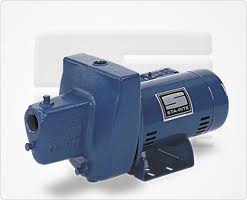 Shallow Well Jet Pumps use centrifugal force to create suction and draw water up from a well in areas where the water table is located less than 25 feet below the ground. They are electrically powered and commonly mounted on pressure tanks. Because they use water to draw water, shallow well pumps must be primed in order to operate. A check valve in the pump’s feed line prevents water from flowing backwards.
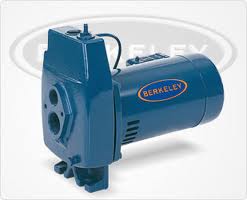 Convertible Deep Well Jet Pumps are used in applications where water is located more than 25 feet underground. These pumps sit above ground but are equipped with a submersible jet ejector assembly that can be used to increase their operating depth to about 90 feet. A foot valve facilitates pump priming and keeps water from flowing backwards.
 Deep Well Submersible Pumps are commonly used in applications deeper than 90 feet. These pumps are submerged in a well and pump water up through a single pipe connected to a pressure tank. They are more efficient than jet pumps but can be harder to maintain as pump or motor problems often require pulling the unit up to ground level for repairs. In general, submersibles can function for 20 to 25 years without servicing.
SIZING A WELL PUMP
The size of a well pump directly affects its efficiency, lifespan and ultimate cost. An undersized pump will result in low water pressure, while an oversized model will consume more energy than necessary. Both scenarios will result in excessive wear on the system.
To correctly size a well pump you must determine:
• The water pressure required (psi).
• The level of your water source.
• The rate of water source replenishment in gallons per minute (gpm)
• The total number of stories the water will be pumped (vertical lift).
• The amount of water the pump must deliver during peak hours in gpm.
Assuming all of the parameters fall within a normal range, a two-storey, two bathroom residential system with an average demand of about 12 gpm can generally function with a ½ horsepower (hp) well pump. Larger applications of 15 gpm or more will require a more powerful pump.
WELL PUMP FEATURES
A pressure tank helps maintain even water pressure.
A check valve keeps water from flowing backwards in shallow well jet pumps.
A foot valve keeps water from flowing backwards in convertible well pumps.
Thermal and overload protection prevents motor burnout.
A booster increases (psi) in shallow well pumps to maintain consistent water pressure.
Ask Our Experts?



PAYMENT METHODS